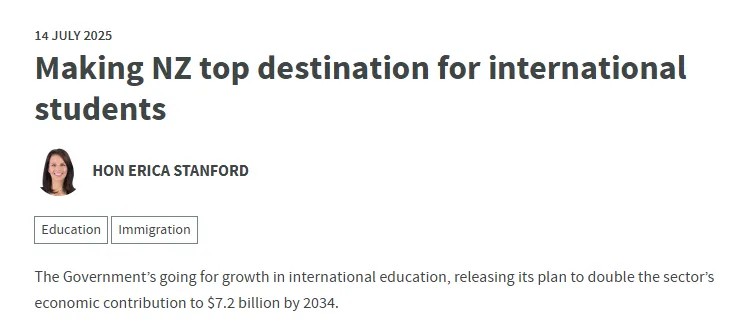
Recently, the New Zealand government released the International Education Growth Plan, proposing to expand the scale of the international education industry to NZD 7.2 billion by 2034. To achieve this goal, the New Zealand Immigration Department and the Ministry of Education have simultaneously launched multiple policy adjustments to provide more support for international students in terms of work permissions, visa convenience, and other aspects. For students planning to study in New Zealand, these policies will bring tangible convenience.
1、 Work permission upgrade: extended working hours and expanded coverage
1. Increase in weekly working hours
Starting from November 3, 2025, eligible student visa holders will have their weekly working hours increased from 20 hours to 25 hours during their school years. This means that students can earn more income through part-time jobs, reducing the pressure of living costs. It is worth noting that:
This policy only applies to new visas issued after November 3, 2025; Students holding old visas who wish to enjoy an additional 5 hours of work privileges can apply for a "visa condition change", but must pay the corresponding application fee; The right to full-time work during holidays (such as summer vacation) remains unchanged, and students can use the long holiday to concentrate on work and accumulate experience.
2. Work rights cover more projects
Previously, students in short-term exchange programs or study abroad programs (such as only one semester) may not be able to enjoy work rights. The new policy includes this, and all students participating in approved higher education exchange or study abroad programs can obtain corresponding work rights, which will help them integrate more deeply into local life.
2、 Visa policy optimization: Short term work visas and multi-year visas are more flexible
1. Add a short-term work visa
New Zealand will introduce a short-term work visa for up to 6 months for some international graduates who do not meet the requirements for a post graduation work visa. This provides a buffer period for graduates to find jobs related to their profession through the "Approved Employer Work Visa (AEWV)" channel, increasing the possibility of retaining new employment opportunities.
2. Simplification of multi-year visa applications
After the policy adjustment, it will be more convenient for students to apply for multi-year visas. For students pursuing long-term courses such as undergraduate and master's degrees, there is no need for frequent renewals, which reduces the complexity of procedures and allows them to focus more on their studies.
3、 Other convenient measures: simultaneous relaxation of visa and entry policies
1. Fast track for student visa application
The New Zealand Immigration Department now accepts overseas applicants to apply for student visas using a "conditional admission letter". As long as the conditions on the letter only involve academic or language requirements (such as completing language courses and achieving a specific GPA), the application can be submitted. This measure shortens the visa approval cycle and allows students to determine their study abroad plans earlier.
2. Facilitation of entry policies
Starting from November 2025, Chinese tourists holding valid Australian visas who travel from Australia to New Zealand only need to apply for an "Electronic Travel Authorization (NZeTA)" and do not need to apply for an additional New Zealand visa. They can stay for up to 3 months after entry. Although this policy mainly targets tourists, it also provides travel convenience for students planning security checks in multiple countries.
4、 Behind the policy: Why is New Zealand increasing its efforts in international education?
New Zealand Education Minister Erika Stanford stated that international education is one of New Zealand's important export industries, injecting NZD 3.6 billion into the economy by 2024. In addition to economic contributions, international students also provide assistance for scientific research cooperation, trade exchanges, and cultural exchanges. The long-term goals of the International Education Growth Plan include:
By 2034, the global awareness of New Zealand as a study abroad destination will increase from 40% in 2024 to 44%;
The number of international students enrolled has increased from 83400 in 2024 to 119000 in 2034;
More potential students list New Zealand as their top three preferred choices for studying abroad.
This policy adjustment is based on practical needs such as work and visas, providing a more friendly environment for international students. For students planning to study abroad in new countries, it is important to focus on utilizing extended working hours, balancing academic and part-time work, and accumulating local work experience; Utilize short-term work visas to increase opportunities for employment after graduation; Plan the application time as early as possible and use the "conditional admission letter" to speed up the visa process.
With the increasing emphasis on international education in New Zealand, there may be more favorable measures introduced in the future. Interested students can continue to follow official updates and combine their professional plans (such as New Zealand's strengths in agriculture, environmental science, engineering, etc.) to seize policy dividends and make their study abroad journey smoother.
(Note: The above policies are subject to the new release on the official website of the New Zealand government. It is recommended to confirm the details through official channels before applying.)